
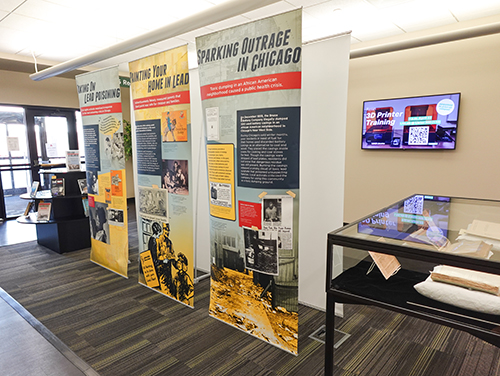
“This Lead is Killing Us: A History of Citizens Fighting Lead Poisoning in Their Communities,” a traveling exhibition curated by the National Library of Medicine, will exhibit April 6-May 16 on the first floor of Lister Hill Library of the Health Sciences. Specially curated items from UAB Historical Collections and UAB Libraries’ circulating collections also will be on display.
The exhibit explores how citizens have advocated for themselves to lead industries, housing authorities and elected officials to protect their health against lead poisoning in their communities.
"Birmingham grew as a city of heavy industry, a heritage we are still dealing with today,” said James Gilbreath, reference librarian and liaison to the School of Nursing. “We are excited to host this exhibit that tells a story so familiar to our communities and our own fights about pollution from coke and steel production, and we’re glad to showcase other interesting and relevant resources from our collections as well."
In conjunction with “This Lead is Killing Us,” Blazers can attend additional special programming April 14 and 15 to learn more.
- Empowering Communities: A Participatory Approach to Environmental Education and Health Communication on Lead Exposure — 11 a.m. April 14, School of Nursing Florence Nightingale Room
Shaul Gayle, doctoral candidate in the School of Public Health, will share their research and work in community education surrounding lead exposure and evidence-based, community-centered interventions to health risks. - Blazer Book Club Special Event: “What the Eyes Don’t See” by Mona Hanna-Attisha, M.D. — 6 p.m. April 15, Lister Hill Library Fletcher Room (251A)
“What the Eyes Don’t See” tells the story of how Hattish, a pediatrician, professor and public health advocate, and a team of researchers, parents, friends and community leaders discovered that the children of Flint, Michigan, were being exposed to lead in their tap water, and the community advocacy work that followed.
To discover more about the exhibit and where it will head next, visit the National Library of Medicine website.