
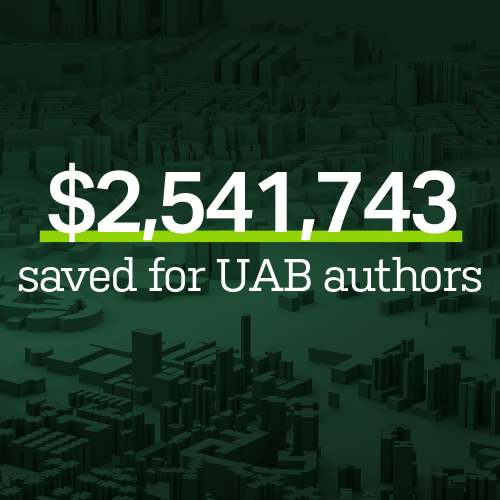
Twelve agreements between UAB Libraries and top journal publishers have saved authors more than $2.5 million in costs associated with publishing in open access journals since 2021 — an increase of nearly $525,000 in savings since October 2025 alone.
The cost-saving mechanism in these agreements waives the article processing charge (APC) for UAB authors. Unlike traditional publishing systems, open access journals do not require a subscription to access paywalled resources, and to offset that loss of revenue, most collect a charge in order to publish. In the United States, the average reported APC cost is more than $2,100, with a median cost of $2,000, according to data collected by the National Institutes of Health.
A read-and-publish agreement with publisher Springer Nature, signed in January 2023, has saved UAB authors more than $1 million, and an agreement with Wiley signed in January 2024 has saved more than $1.2 million. These two agreements alone enable lead or corresponding authors affiliated with the university to publish open access in qualifying fully open access or hybrid open access Wiley or Springer Nature journals at no cost to the author — nearly 4,000 journals in total.
“It remains a top priority to enable UAB authors to publish open access,” said Jeff Graveline, J.D., associate dean for Research and Scholarly Communication and director of the Office of Scholarly Communication in UAB Libraries. “OA publishing promotes collaboration, which sparks innovation and change, which are at the heart of UAB’s mission.”
Other publishers with whom UAB Libraries has signed read-and-publish agreements include ACM, Cambridge University Press, Cold Spring Harbor, Emerald Publishing, IOP Publishing, Mary Ann Liebert (now owned by Sage), Royal Society of Chemistry and The Company of Biologists. In January 2026, two additional agreements were made between UAB Libraries and publishers Taylor and Francis and the American Chemical Society.
Questions? UAB Libraries can help
Do you have questions about making your work more accessible through open access publishing? The Office of Scholarly Communication can help. And that’s not all they do — the OSC can answer questions from Blazers about publishing agreements and understanding copyright guidelines, as well as provide guidance on incorporating affordable instructional materials into courses.
The OSC also provides research data management services, offering consultations with researchers to prepare data management plans or select repositories for data. The office also offers instruction on how to organize, document and properly safeguard research data to benefit both research teams and the wider research community long-term.